
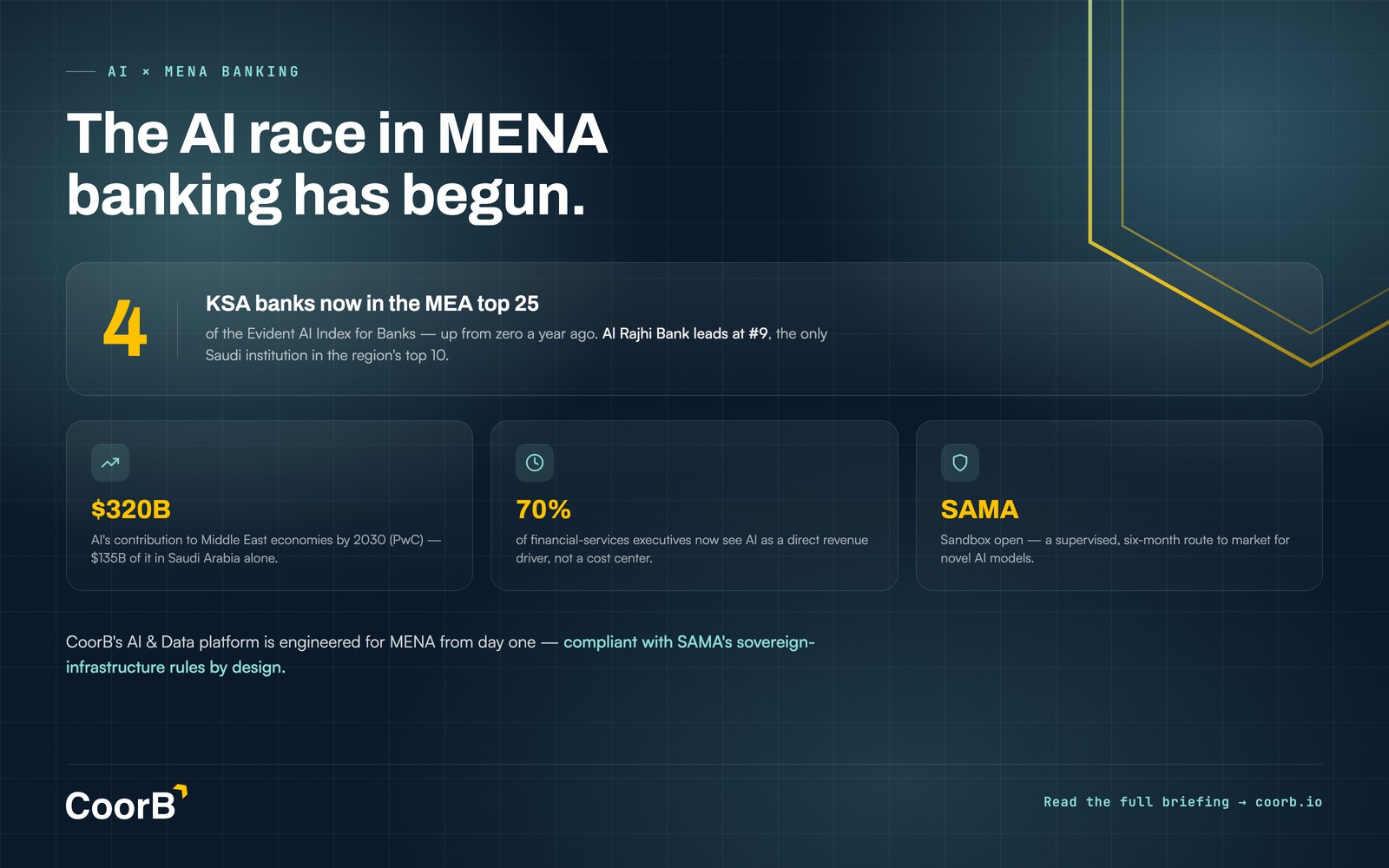
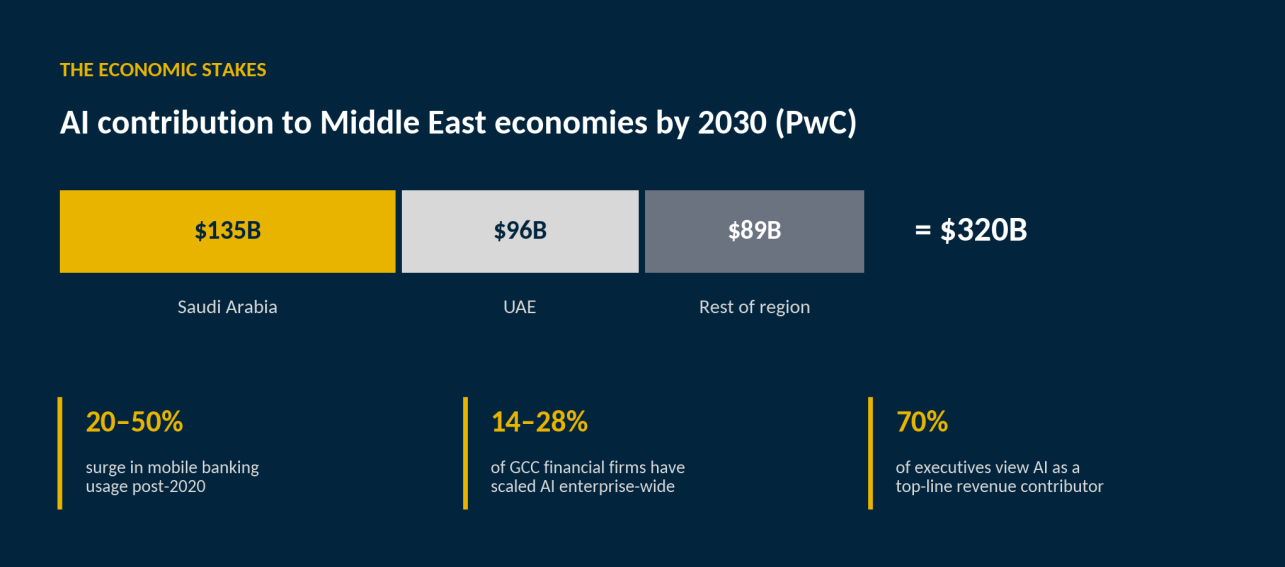
PwC forecasts AI will add $320B to Middle East economies by 2030 — yet only 14–28% of GCC financial firms have scaled it enterprise-wide. The gap isn't algorithmic capability. It's execution.
AI has become core banking infrastructure
Banking is pivoting from deterministic, rules-based systems to probabilistic, self-learning architectures — and the econometric evidence links AI adoption directly to higher return on assets and equity. PwC forecasts $320B in AI contribution to Middle East economies by 2030, $135B of it in Saudi Arabia alone. But only 14–28% of GCC financial firms have scaled AI enterprise-wide. Disciplined execution, not algorithmic capability, is the actual competitive frontier.
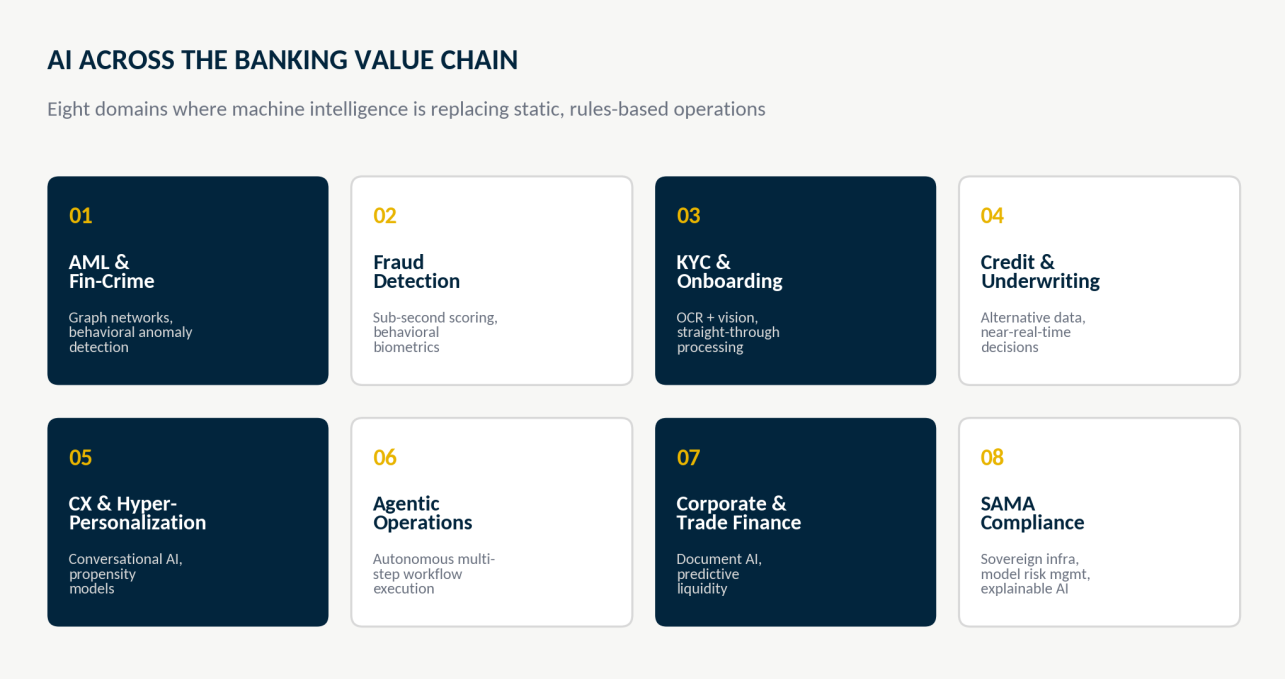
Eight domains where AI is replacing static operations
The shift isn't confined to one function. Across the banking value chain — AML and financial-crime monitoring, fraud detection, KYC and onboarding, credit and underwriting, customer experience, agentic operations, corporate and trade finance, and SAMA compliance itself — machine intelligence is replacing rules-based logic with continuously-learning, behavioral models.
Anti-money laundering: the false-positive economics finally break
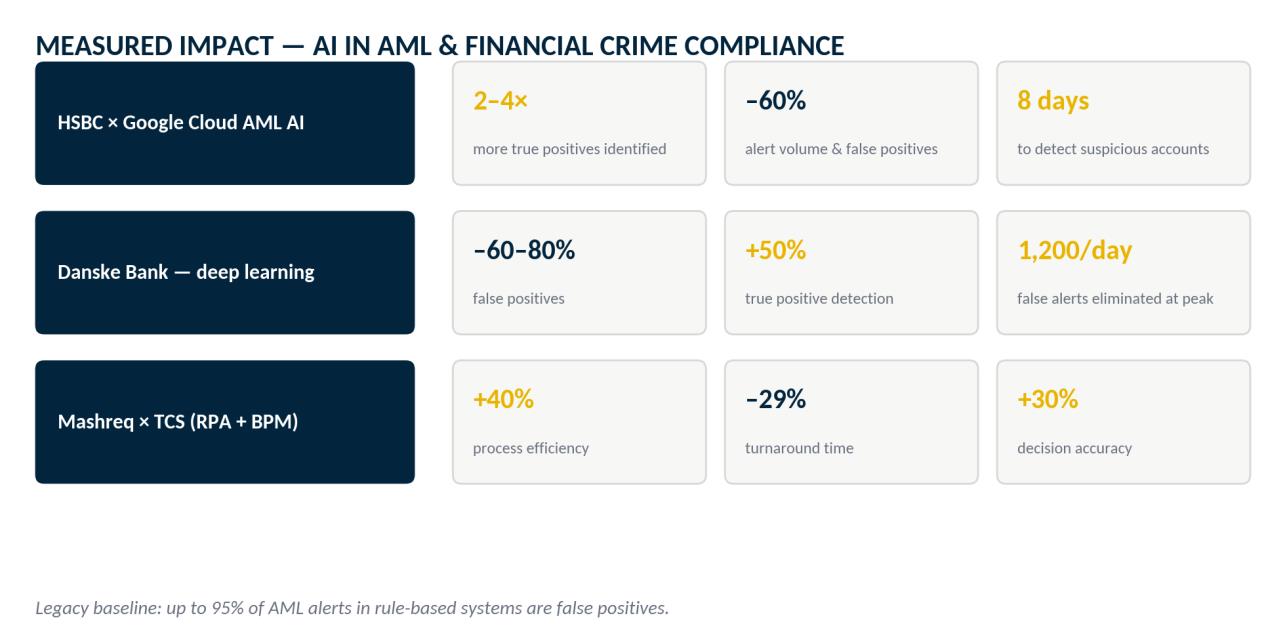
Legacy AML rests on rigid boolean thresholds — up to 95% of alerts from rule-based systems are false positives, millions of investigator hours spent on dead ends while genuine illicit networks operate just below static thresholds. HSBC's AML AI with Google Cloud screens 1.2 billion transactions monthly and delivers 2–4× more true positives while cutting alert volume 60%, compressing suspicious-account detection to eight days. Danske Bank's deep-learning system replaced a 40% detection rate and 1,200 daily false positives with a champion/challenger architecture — false positives fell 60–80% while true-positive detection rose 50%.
Fraud detection at sub-second latency
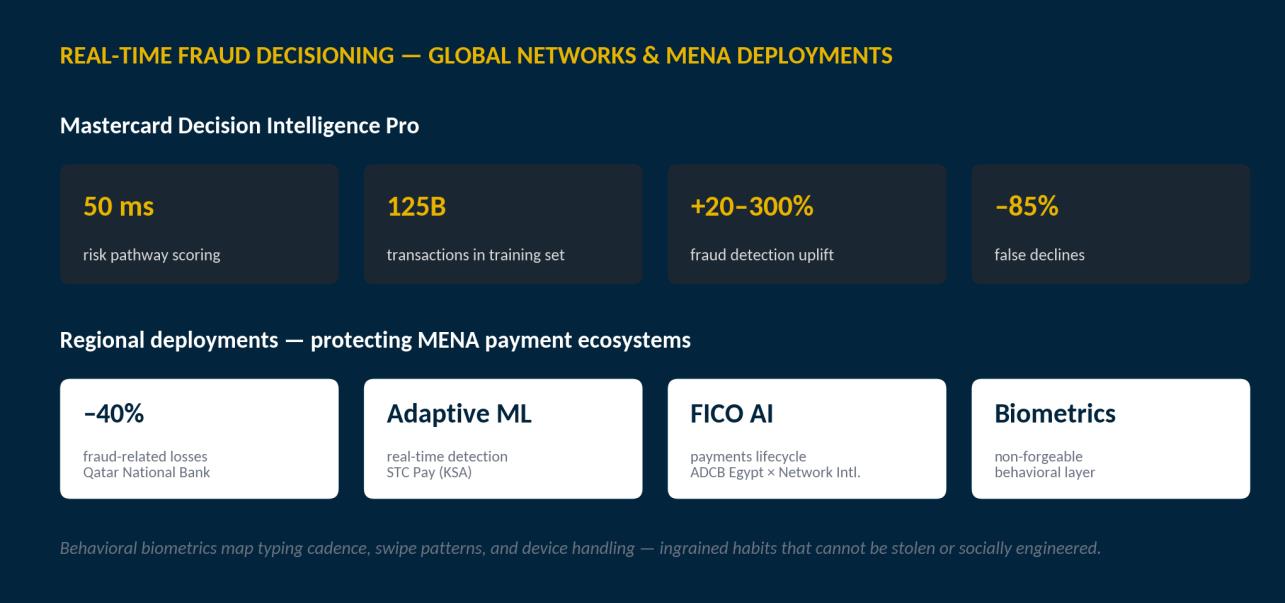
Fraud interception demands sub-second decisions, and adversaries now weaponize generative AI for synthetic identities and deepfake phishing at scale. Mastercard's Decision Intelligence Pro, trained on roughly 125 billion annual transactions, scores relational risk pathways in 50 milliseconds — lifting detection 20–300% in evasive edge cases while cutting false declines over 85%. In the region, STC Pay runs self-adapting ML models that absorb novel fraud typologies without manual rule updates, and Qatar National Bank cut fraud-related losses 40% through AI-driven cybersecurity and biometric authentication — a non-forgeable layer, since typing cadence and swipe patterns can't be stolen or socially engineered.
Credit risk moves from days-weeks to near real-time
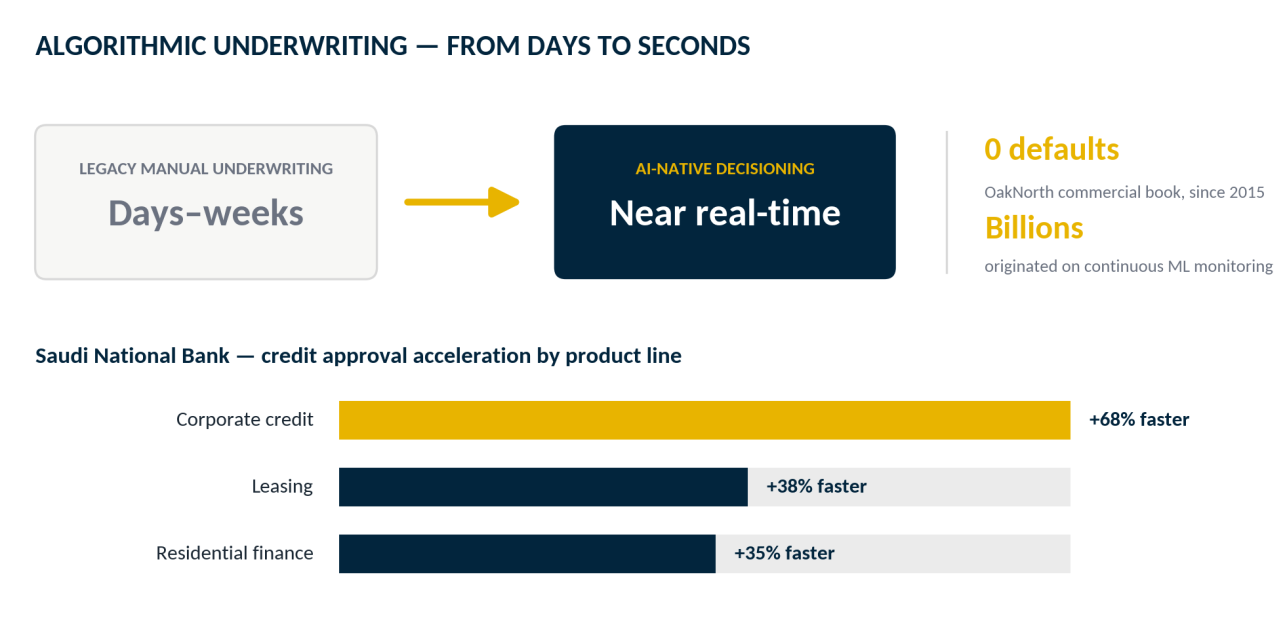
Traditional scorecards penalize thin-file customers and SMEs with non-standard cash flows. AI-native decisioning changes the unit economics: OakNorth has originated billions in commercial loans with zero defaults since 2015 by triangulating alternative data instead of static covenants. In the Kingdom, Saudi National Bank's decision trees and deep residual networks accelerate corporate credit approvals 68%, leasing 38%, and residential finance 35% — while gradient-boosted models handle the data sparsity of Islamic microfinance without compromising Shariah compliance.
Agentic AI resets the productivity baseline
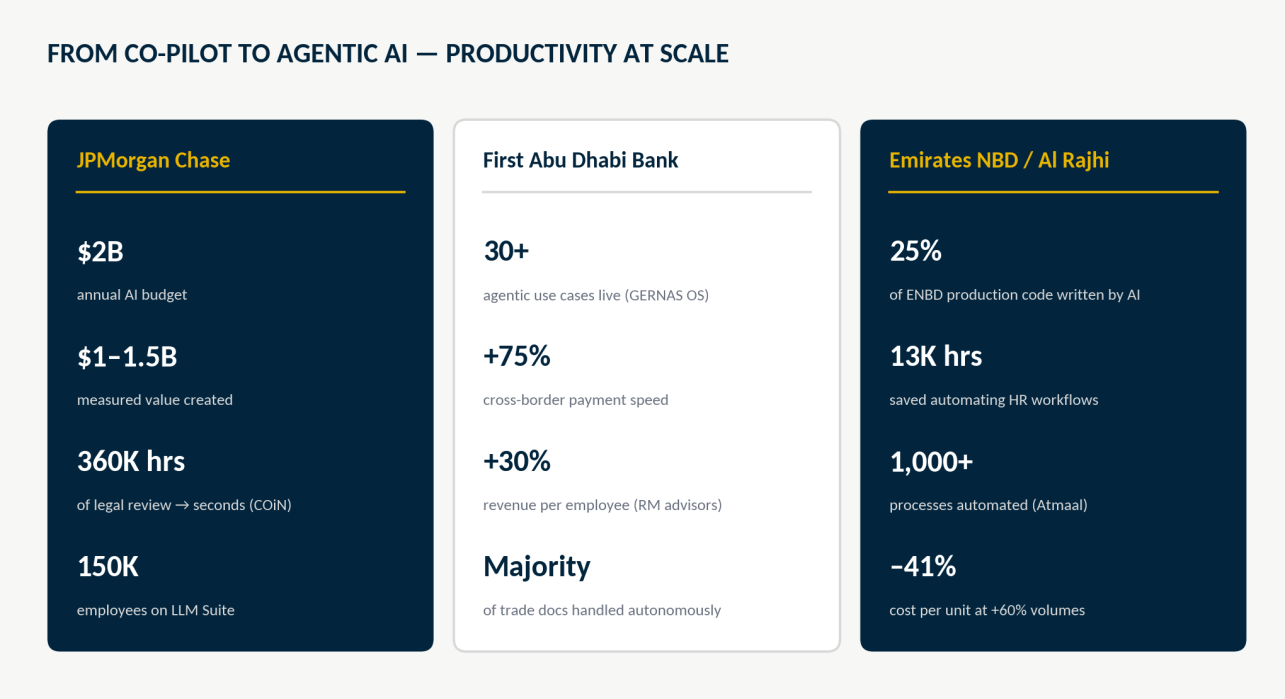
The decisive shift is from assistive co-pilots to agentic architectures that autonomously plan, reason, call APIs, and orchestrate multi-step workflows. JPMorgan Chase runs AI as core infrastructure — a $2B annual budget, contract intelligence that replaced 360,000 hours of legal review, and $1–1.5B in measured value creation. First Abu Dhabi Bank runs 30+ live agentic use cases with cross-border payment speeds up 75% and revenue per relationship manager up 30%. Emirates NBD and Al Rajhi's Atmaal subsidiary have pushed automation deep enough that AI now writes over 25% of production code at ENBD and Atmaal has cut cost per unit 41% while absorbing 60% volume growth.
Where the region's banks actually rank today
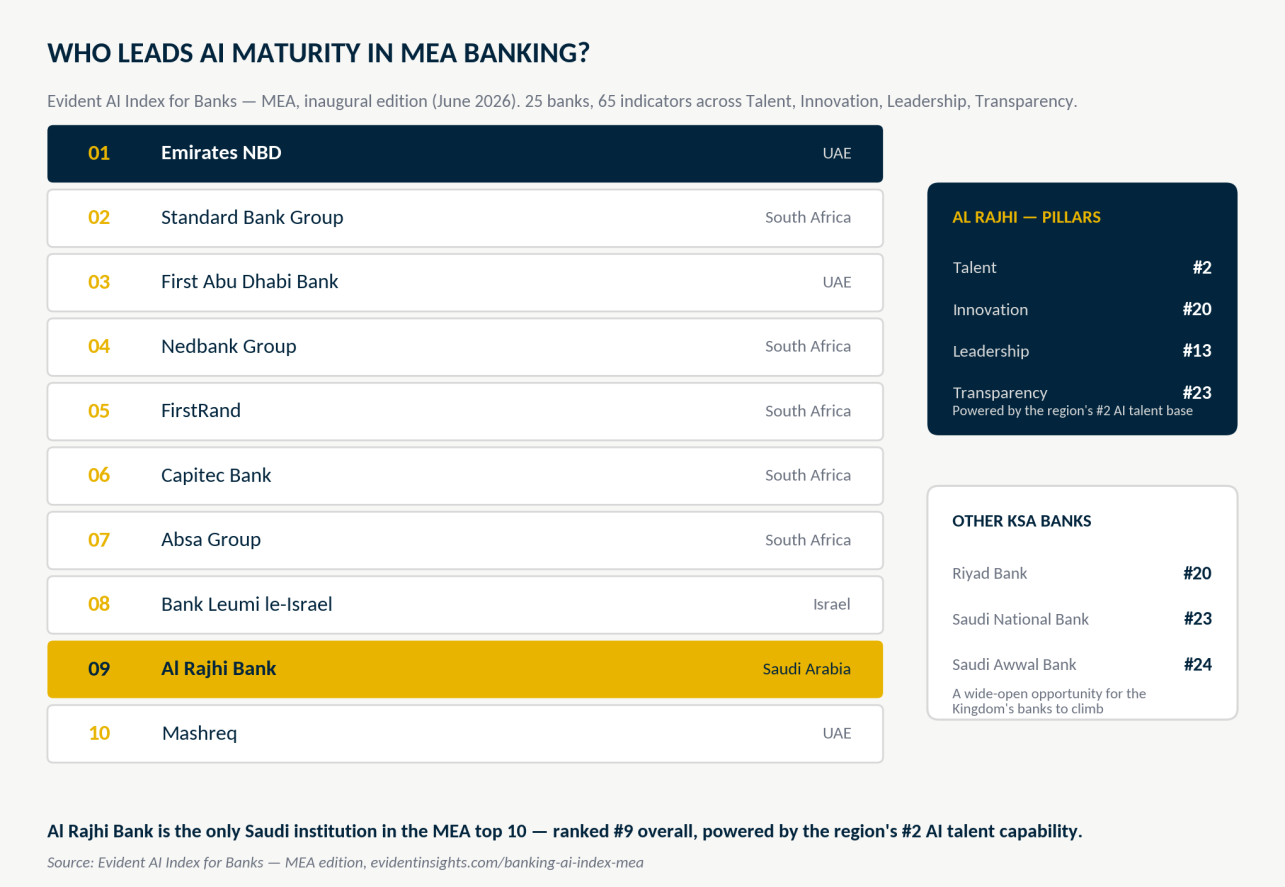
These claims are now independently benchmarked. The inaugural Evident AI Index for Banks — MEA edition (June 2026) scored 25 of the region's largest banks against 65 indicators across Talent, Innovation, Leadership, and Transparency. Emirates NBD ranked first and First Abu Dhabi Bank third. Al Rajhi Bank, at #9, is the only Saudi institution in the top 10 — carried by the region's #2-ranked AI talent base but held back by innovation and transparency scores. The next Saudi entrant appears only at #20. That gap is the headroom: Vision 2030 investment hasn't yet converted into measured AI maturity for most of the Kingdom's banks.
SAMA compliance is a catalyst, not a barrier
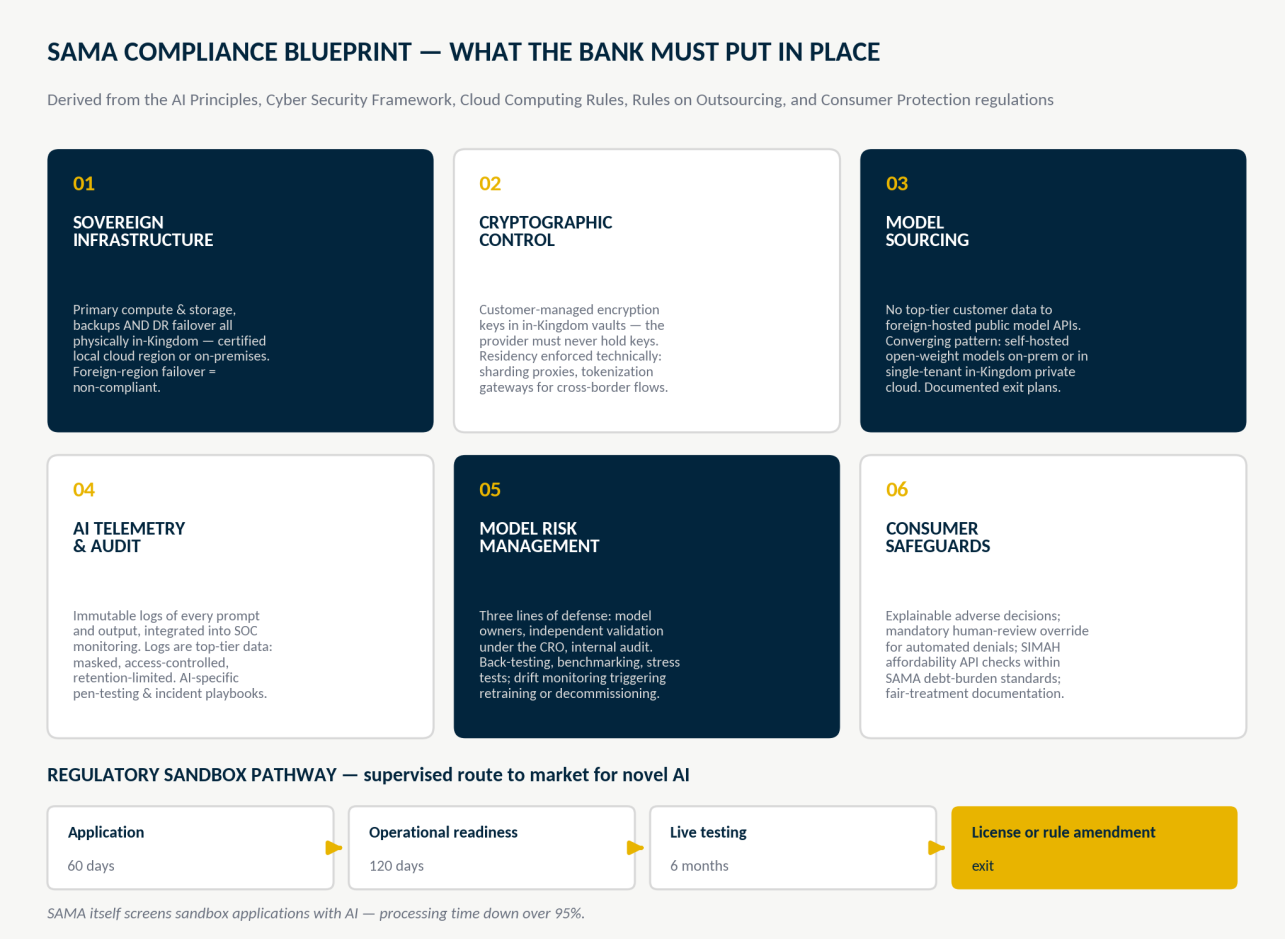
Regulation is where most transformation programs stall — but it shouldn't be. SAMA governs AI through five binding instruments, and the unifying logic is straightforward: it regulates the data models consume, the infrastructure they run on, and the vendors that supply them. In practice that means primary compute, storage, and disaster recovery physically in-Kingdom; customer-managed encryption keys the provider never holds; no top-tier customer data to foreign-hosted public model APIs; and a three-lines-of-defense model risk framework with continuous drift monitoring. Institutions that treat these as design constraints from day one end up with sovereign, explainable AI — not a compliance patch bolted on after the fact. Novel models without a clear regulatory path have a supervised route to market through SAMA's sandbox: 60 days to apply, 120 days of operational-readiness work, six months of live testing, then a full license or rule amendment.
Execution is what separates pilots from platforms
The pattern across every deployment in this briefing — AML, fraud, underwriting, agentic operations — is the same: value shows up when AI is wired into production workflows on compliant, sovereign infrastructure, not when it's demoed in a sandbox. That's the exact terrain CoorB's AI & Data layer and platform foundation are built for: private and on-prem inference, SAMA-aligned governance, and decisioning wired into the core from the start, so AI adoption compounds instead of stalling at proof-of-concept.